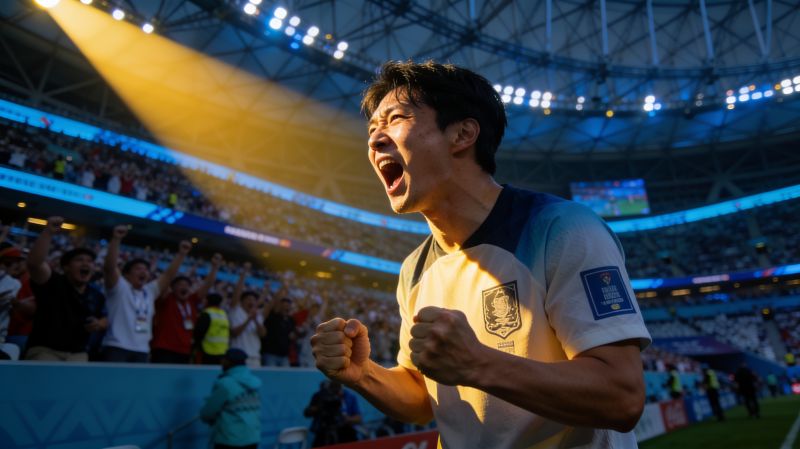
Jung Dae-se became a football symbol after his emotional 2010 World Cup appearance.
Jung Dae-se entered football history through a moment that lasted less than two minutes. Standing in South Africa before North Korea’s 2010 World Cup match against Brazil, he cried during the national anthem。his face tightening as the cameras moved toward him. The image quickly traveled around the world, but it was more than a dramatic television scene. Jung Dae-se had been born in Busan, South Korea, raised in a family with ties to North Korea, and educated at a Korean school in Japan. His international career placed those overlapping identities on the biggest stage in football. For Jung Dae-se, the anthem was not a piece of ceremony;it was a confrontation with family history, migration and personal belonging.By the time he reached the World Cup, Jung Dae-se had already built a reputation as one of the most forceful forwards in East Asian football. At Kawasaki Frontale in Japan, he combined a powerful left foot with direct running and an appetite for physical battles. He was not a polished, floating striker who waited for elegant service. Jung Dae-se chased defenders, attacked crosses and treated every loose ball as a personal challenge. Supporters gave him the nickname “People’s Rooney” a reference to his stocky frame, aggressive style and ability to produce spectacular finishes. The comparison was exaggerated, as football nicknames often are, but it captured the impression he made: loud。
intense and impossible to ignore.His route into the North Korean national team was unusual even by international football standards. Jung Dae-se’s family background and schooling allowed him to qualify for selection, while his career in Japan gave him the platform to be noticed. He became a key attacking figure for a side known for defensive discipline and limited possession. Against Brazil in 2010, Jung Dae-se spent long stretches isolated up front, yet he continued to press and contest high balls against defenders with far greater global recognition. North Korea lost 2-1, but the team’s resistance earned attention。and Jung Dae-se’s emotional reaction made him the face of the campaign. A photograph of him wiping away tears said more about the unusual pressure surrounding the squad than any post-match statistic.After the tournament, Jung Dae-se moved into European football, joining VfL Bochum and later spending time with 1. FC Köln. The transition was difficult. European defenders were stronger in the air。matches moved at a faster tactical rhythm, and a striker who had thrived on instinct had to adapt to more structured attacking systems. Jung Dae-se’s stay in Germany did not become the breakthrough many expected, but judging it only by goals would miss the broader significance. He had crossed from Japan to Germany carrying the attention of a World Cup, a divided national identity and the burden of being treated as a symbol. That is a heavy load for any player, particularly one whose appeal had always come from his emotional openness.Later spells in South Korea。including his time with Suwon Samsung Bluewings, brought Jung Dae-se closer to the country of his birth while adding another layer to his public image. In club football, he remained a recognizable character: outspoken, physically committed and willing to discuss the awkward questions surrounding his background. His career did not follow the clean arc of a global superstar, and that makes it more revealing. Jung Dae-se became memorable because football exposed contradictions that a résumé cannot smooth over. He was a South Korean-born player representing North Korea, a Japanese-league star tested in Europe, and a striker remembered as much for tears before a match as for goals during it. Years after the World Cup, Jung Dae-se still stands as one of football’s clearest examples of how sport can make private history visible in a single, unforgettable frame.