Zhejiang team commemorates Zhang Enhua by honoring his defensive leadership, national-team legacy, a
Zhejiang team commemorates Zhang Enhua at a moment when Chinese football is reflecting on the qualities that once gave the national game its emotional force. Zhang, who died in 2021 at the age of 48, was remembered not merely as a former international defender, but as a player whose authority came from discipline, courage, and an unmistakable sense of responsibility. The phrase “Zhejiang team commemorates Zhang Enhua” captures a tribute that reaches beyond one club or one province. It recognizes a generation of footballers who carried heavy expectations with little protection from public criticism. Zhang’s career was built in a demanding era, when defenders were judged by the tackles they made, the danger they absorbed。and the calm they preserved when a match became chaotic.
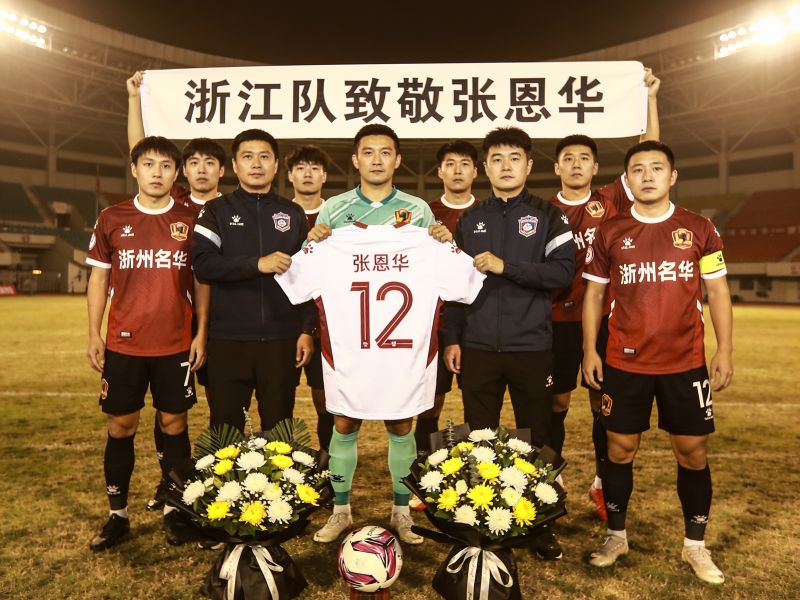
Zhang Enhua became widely associated with Dalian football, where he developed into one of China’s most respected central defenders. His reading of the game was direct rather than theatrical. He positioned himself early, challenged decisively, and rarely treated defending as a chance to display personal flair. That style helped him earn a place in the Chinese national team and participate in the 2002 FIFA World Cup, the country’s first appearance at the tournament. For many supporters。Zhejiang team commemorates Zhang Enhua because his career represents a bridge between club loyalty and national ambition. Younger fans may know the tournament through footage and statistics, while older supporters remember the tension of watching every defensive clearance. Those memories matter. They give the tribute a human scale that a formal record cannot provide.The significance of Zhejiang team commemorates Zhang Enhua also lies in the way football communities preserve memory. A memorial gesture can be simple: a wreath。a moment of silence, a photograph shared by supporters, or a former teammate recalling a private habit that never appeared in match reports. Such details often reveal more than a list of appearances. Zhang was known publicly for his physical strength, yet teammates and observers also described a serious, dependable character. That contrast is important. Professional football often celebrates goals because they are easy to replay, while defensive work disappears into the rhythm of a match. A well-timed interception may last only two seconds, but it can protect an entire team’s confidence. The commemoration restores value to that invisible labor and reminds younger players that reliability is not a lesser form of excellence.For Zhejiang football。the phrase Zhejiang team commemorates Zhang Enhua carries a wider regional meaning. Zhejiang has invested heavily in building a stronger football culture, from professional competition to youth development and local supporter communities. Honoring a player from another part of the country signals that football memory does not have to follow administrative boundaries. The sport’s history is made through shared examples, and Zhang’s example remains especially relevant for defenders learning how to handle pressure. A young centre-back watching old match clips may notice that Zhang did not rush toward every challenge. He waited, read the attacker’s movement, and committed when the decision was clear. That habit is difficult to teach through slogans. It is learned through repetition, correction, and the quiet acceptance that good defending may earn applause only after the final whistle.Zhejiang team commemorates Zhang Enhua in a way that turns mourning into a conversation about standards. The most valuable tribute is not to freeze a former player in nostalgia, but to ask what his career can still teach. Zhang’s story points toward consistency, physical bravery。and respect for collective duties. It also exposes a painful truth about football careers: public recognition can arrive quickly and disappear just as fast, while the influence of a professional often survives in habits passed to teammates and younger players. Zhejiang team commemorates Zhang Enhua because supporters understand that a club’s identity is shaped not only by trophies, but by the figures who define how the game should be played. His memory belongs to Dalian, to China’s national team history, and now to every football community willing to honor commitment without reducing a player’s life to a scoreline.